Hidden leaks, slab leaks and water line leaks
Leak Detection and Repair in Torrance, CA
A water bill that jumped, a damp spot on the ceiling or the sound of running water? Call or send a request to be connected with an independent Torrance plumber.
Some leaks announce themselves with a drip or a puddle. Others hide: a pinhole in a pipe inside a wall, a hot water line under a concrete floor, or a break in the water line out in the yard. The first clue is often a water bill that jumps for no reason, a meter that keeps moving with every faucet off, a warm spot on a floor, a stain on a ceiling or the faint sound of running water at night. In an apartment or condo building, it may be a stain that shows up in the unit below.
The plumber you are connected with locates the leak, explains the repair options and gives you a price before any walls or floors are opened. Callbacks and on-site availability vary.
A simple check: turn off every fixture and appliance that uses water, then watch the meter. If it still moves, water is going somewhere.
A leak in the main in the street or at the meter is for your water provider. About 78 percent of the city is on Torrance Municipal Water, and the city says after-hours water main breaks in its area go to Torrance Fire Department Dispatch, (310) 781-7042 (city water services). The rest of the city is on Cal Water, according to the city's General Plan environmental report; call the number on your Cal Water bill. The line from the meter to the house is plumbing work: California's C-36 license covers "Water and gas piping from the property owner's side of the utility meter."
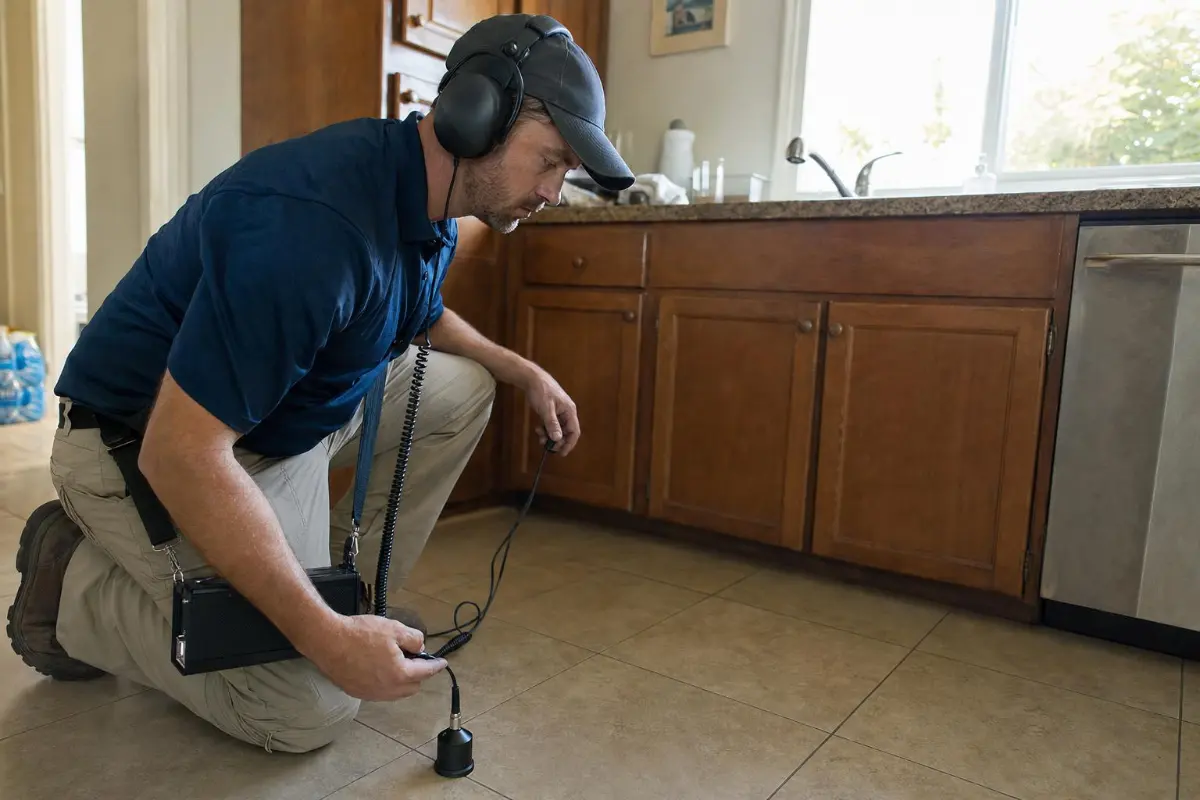
Plumbers find hidden leaks by isolating sections of the system, pressure testing lines, listening for the sound of escaping water with acoustic equipment, and using moisture meters or thermal imaging, so the opening in the wall or floor can be as small as possible. Ask what method they will use and what the detection fee includes.
Repair options depend on where the leak is:
Three local conditions make leaks more likely. First, age: SCAG's housing data shows about 60 percent of Torrance homes built in the 1950s and 1960s, by our math, and supply pipe of that era, often galvanized steel or early copper, can corrode from the inside as a general rule. Second, minerals: Cal Water's 2025 Hermosa-Redondo report shows distribution water averaging 234 parts per million of hardness, and Torrance Municipal Water's 2025 report shows total dissolved solids averaging 540.5 to 695.6 parts per million by source in 2023 sampling; minerals build up in valves and fixtures. Third, earthquakes: shaking can loosen fittings and break rigid connections, which is why SoCalGas recommends flexible gas connectors and the state's strapping guidelines strongly recommend flexible connectors on water heaters.
Torrance Municipal Water's 2024 tap sampling at 200 sites found lead at the 90th percentile not detected and none of the 200 over the action level, per its 2025 report, and the city posts a lead service line inventory with an online map. Cal Water says in its Dominguez report and its Hermosa-Redondo report, "We have no known lead service lines in our systems." California's State Water Board found "no lead reported in nearly 10 million service connections" statewide, but suggests checking fixtures and interior piping, "especially if installed before 2010." If leaks keep showing up in the same kind of pipe, ask whether a section or whole-house repipe makes more sense than chasing pinholes.
The plumber sets the price. These are guides:
What moves the price: how hard the leak is to find and reach, slab versus wall versus yard, the pipe material, how much drywall, flooring or concrete has to be opened and restored, and whether a reroute or repipe is the better fix.
Replacing concealed pipe or a water service line is generally permit work. Inside city limits that means a City of Torrance plumbing permit, filed through the city's online portal since January 5, 2026; Torrance follows the 2025 California Plumbing Code with local amendments, per Municipal Code Section 83.1.1. In unincorporated county pockets, permits go through LA County's Lomita District Office and EPIC-LA. Ask the plumber who will file it. If the water line has to be dug up, contact 811 at least two business days ahead, per SoCalGas's safety insert. Look up any plumber's license on the CSLB's website, and keep the down payment to no more than 10 percent or $1,000, whichever is less, as the CSLB's consumer brochure advises.
A note on how this works: Torrance Plumber Help is an independent referral service, not a plumbing company. Your request goes to an independent plumbing contractor who serves Torrance, and there is no charge for the referral.
These are the leak problems Torrance homeowners and renters most often ask about.
Leaks inside walls, ceilings and floors located with testing and listening equipment.
Leaks under a concrete slab repaired directly or the line rerouted.
Leaks in the line from the meter to the house located and repaired or replaced.
Small leaks in copper or galvanized pipe repaired, with the pipe's condition checked.
Leaking faucets, toilets, shutoff valves and supply connectors repaired or replaced.
Ask what the leak detection fee covers and whether it goes toward the repair.
Ask how they will keep wall and floor openings to a minimum.
Ask who patches drywall, flooring or concrete and whether it is in the price.
Tell us what makes you think there's a leak and get connected with an independent Torrance plumber.
Free — no obligations
Call (424) 390-5879 or send the form. Describe what you have noticed: bills, stains, sounds or a moving meter.
An independent plumber who serves Torrance contacts you. Callbacks and on-site availability vary.
The plumber tests and narrows down the leak before opening anything.
You get repair, reroute or replacement options with prices before work starts.
HomeAdvisor (labeled 2025) puts leak detection at an average of $280, with most people paying $150 to $400, and slab leak repair at an average of $2,280. Angi's Los Angeles page (undated) puts a service call at $100 to $250. The plumber sets the price.
A leak in the main or at the meter is for your water provider, Torrance Municipal Water or Cal Water, shown on your bill. The line from the meter to the house is plumbing work; California's C-36 license covers piping from the property owner's side of the utility meter.
Turn off everything that uses water and watch the meter. If it still moves, water is going somewhere. A jump in the water bill, stains, warm floor spots and musty smells are other signs.
Shaking can loosen fittings and break rigid connections. SoCalGas recommends flexible gas connectors, and state strapping guidelines strongly recommend flexible connectors on water heaters. A plumber can check connectors after a quake.